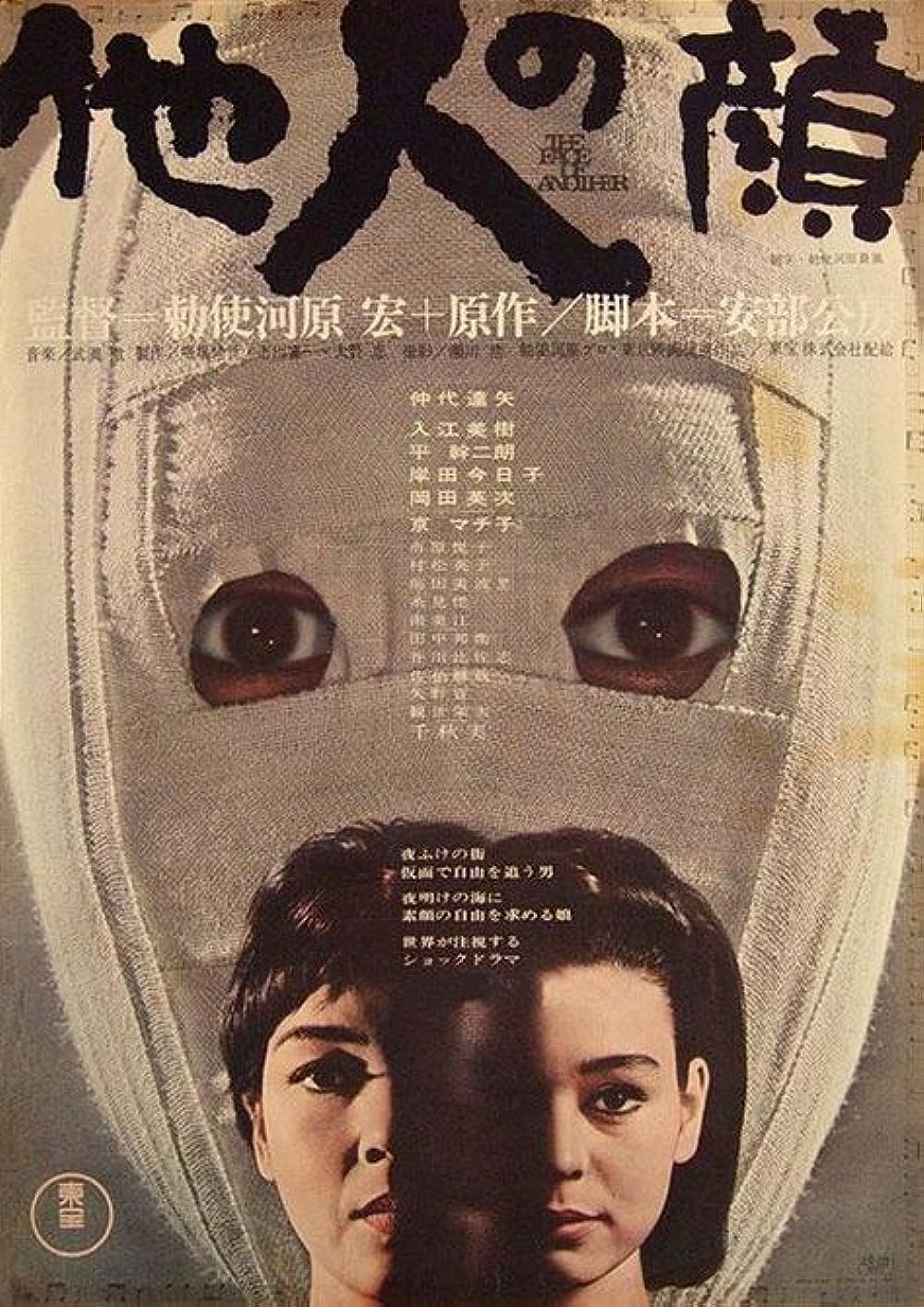

A man sits in an armchair. He sits in darkness, because he does not want his wife to see him; his face is swaddled in bandages. As he plucks a cigarette from between his lips, he leans back. His voice is grim. “I want to put out all the lights in the world,” he says, “or gauge everyone’s eyes out.”
This is one of the many memorable lines from Hiroshi Teshigahara’s movie The Face of Another (1966), based on Kōbō Abe’s novel of the same name. The black-and white film tells the story of a businessman whose face has been badly burnt in an accident. In the beginning, the man is cynical and severely depressed. His wife does not want to make love to him, and in public his bandaged face evokes disgust. However, the tables seem to turn when he receives an amazingly life-like prosthetic mask from his doctor.
The man’s personality begins to shift to fit the new, superficial face. As the film advances, he becomes more and more reckless with this new ability to be anonymous—with a face missing from the police database, with a face even his closest friends fail to recognize, he is practically invisible. Finally, both our faceless man and the movie itself spiral into madness.
I would categorize the film as a psychological thriller. The air is suffocatingly oppressive. In the presence of the bandaged man, the subtle cues of others—such as his wife’s averted eyes—make it evident that they are horrified, though they try their best to hide this. Us human beings cannot help our shallowness; disfigured faces unnerve us. To the tense atmosphere add the dream-like settings, especially the doctor’s office, which is all infinite glass shelves and clutter against a void-white backdrop. Shots are often tilted and blurred, or refrain from showing what the viewer wants to see.
The core theme of the movie is masks.
Firstly, our faces are important. Other human beings recognise us by our faces, but they also read our emotions from the curl of our lips and the arrangement of our brows. As the protagonist puts it, “the face is the door to the mind”. When we lose our faces and are forced to put on a mask, such as bandages or a prosthetic surface, this crucial route of communication is disrupted. Moreover, scars and burns on the face complicate daily life, because other people may refuse to look at the wounds at all—or instead keep staring at them uncomfortably as they pass you on the street.
But, going deeper, the prosthetic mask can be taken as a metaphor for the masks we wear daily while pretending to be people we are really not. In trying to be our true selves, we are often met with the unfortunate truth that not everyone likes who we really are. So it is easier to hide, easier to charm and seduce, easier to mold our personalities into something we’ve deemed desirable. We put up a show, we put on a mask. All of us do. And in this world where everyone hides behind artificial masks, can we ever really know our next-door neighbors, our lovers, our husbands and wives—can we even know ourselves?
Before watching the movie, the concept of a two-hour black-and-white film daunted me; but the tension held up surprisingly well, and only in the final ten minutes did I find myself growing restless. All in all, The Mask of Another is a consistently absurd, thought-provoking film, with an ambiguous ending that lingers in the mind. (However, unless your crush is a movie connoisseur with a special fondness for old, obscure Japanese films, I’d advise against picking it for your movie date.)

